

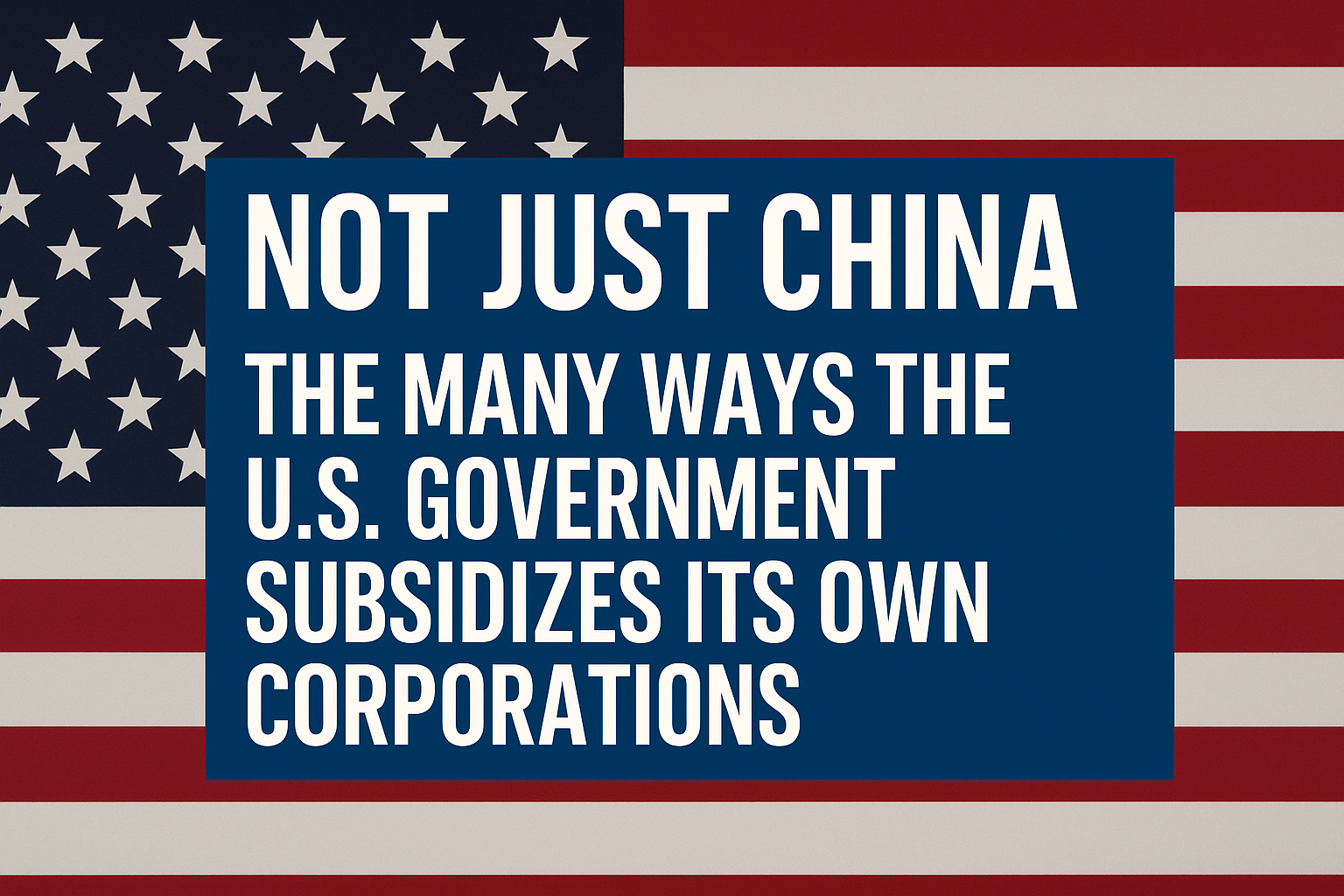
The notion that Chinese companies thrive solely due to heavy state subsidies has become a common refrain in U.S. political and business discourse. While it’s true that the Chinese government plays an outsized role in supporting its industrial base, it’s misleading to suggest that U.S. companies operate in a pure free-market vacuum. In reality, American firms benefit from a sophisticated and multilayered system of government support. In some cases, it rivals or exceeds what Chinese companies receive.
Direct Funding: The CHIPS Act
The most visible example of U.S. tech subsidies is the CHIPS and Science Act, passed in 2022. It allocated $52 billion in federal funding and tax incentives to boost domestic semiconductor manufacturing. The goal was to reduce reliance on foreign supply chains, especially China, and to reestablish U.S. leadership in chip production. Major beneficiaries include Intel, TSMC, and Micron. These companies are now building or expanding fabs with government support. While the investments are justified as essential to national security, they are also clear-cut subsidies to some of the world’s wealthiest tech firms.
The Dollar Advantage
Beyond direct funding like the CHIPS Act, the U.S. holds a unique structural advantage: the global dominance of the U.S. dollar. As the world’s reserve currency, the dollar allows American companies to trade and import in their own currency. This reduces transaction costs, shields firms from exchange rate volatility, and enables easier access to global financing. In contrast, firms in countries without a globally convertible currency must accumulate reserves, mainly U.S. dollars, just to trade. That often puts enormous pressure on their central banks.
Federal Contracts and Procurement
Federal procurement and defense spending are other major levers of support. The U.S. government is one of the largest buyers in the world. It heavily favors domestic corporations. Defense contractors like Lockheed Martin and Raytheon rely on Pentagon contracts. Meanwhile, tech giants such as Microsoft, Amazon, and Oracle compete for multi-billion-dollar cloud and cybersecurity deals from federal agencies. This procurement policy acts as a steady revenue stream for American firms.
Public R&D: Fueling Innovation
U.S. innovation is also heavily supported by public research and development funding. Agencies like DARPA, the National Science Foundation (NSF), and the National Institutes of Health (NIH) finance foundational research. Private companies later commercialize these breakthroughs. From the internet to GPS to mRNA vaccines, many core technologies behind today’s top firms were born from taxpayer-funded research.
Monetary Policy and Bailouts
Monetary policy provides indirect but powerful support. The Federal Reserve helps corporations by keeping interest rates low and injecting liquidity through quantitative easing. During crises, such as the 2008 collapse or the 2020 pandemic, the Fed and Treasury step in. They offer bailouts and relief packages to stabilize major firms. Airlines, automakers, and banks have all benefited from this safety net.
Energy Subsidies
Energy subsidies also play a crucial role. Fossil fuel companies receive billions in tax breaks and incentives. Renewable energy firms benefit from production and investment tax credits. These programs lower capital costs and drive sector growth.
Global Geopolitical Leverage and IP Protection
On the global stage, intellectual property enforcement and U.S. geopolitical leverage offer another form of advantage. The U.S. defends patents and IP rights aggressively through trade agreements and lawsuits. This allows companies in pharma, software, and media to extract monopoly-like profits worldwide. At the same time, Washington uses its economic and military influence to open markets and secure favorable terms for its businesses, from oil to tech exports.
Conclusion
While China’s subsidies are more centralized and visible, the United States operates a complex web of financial, regulatory, and geopolitical support. These mechanisms lower costs, enhance stability, and secure privileged access for American firms. All of it amounts to significant government backing. Before pointing fingers abroad, it’s worth recognizing the many ways the U.S. props up its own corporate champions.