



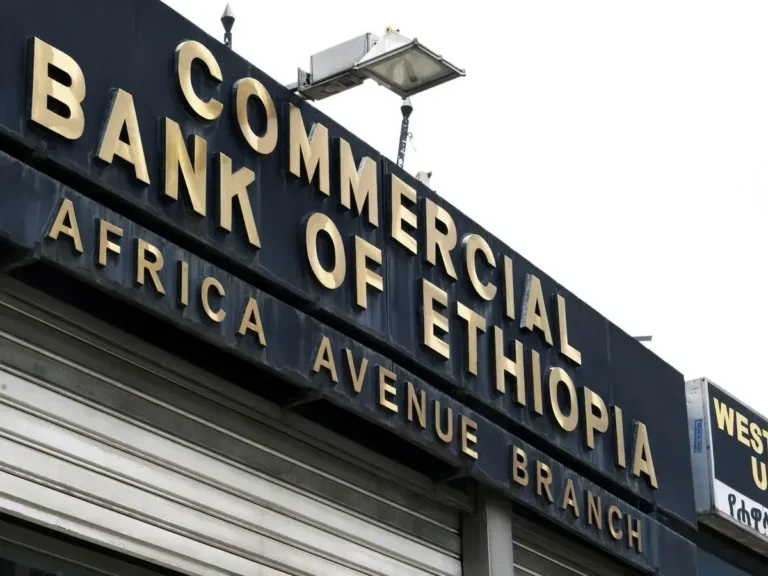
After decades of gradual market share decline, the Commercial Bank of Ethiopia (CBE) is making a strong comeback. In the mid-1990s, CBE controlled over 93% of all deposits and nearly 84% of total loans in the banking system, an era of near-monopoly. As private banks aggressively expanded over the years, they set new benchmarks that came to define market leadership.
By mid-2024, CBE’s share of total banking sector assets had fallen to just 43.7%. In a surprising shift, that number surged back to 50.4% as of January 2025, a sharp reversal driven by structural reforms, government backing, and digital dominance.
Market Share Down, Profits Up Until Now
Even as its market share declined over the years, CBE consistently grew its profits. The bank’s size, strong government ties, and access to key corporate clients gave it an edge. By February 2025, it posted record profits of 1.541 trillion birr and total assets of 2.073 trillion birr. Its loan and bond portfolio reached 1.393 trillion birr.
A Turning Point: Reversing Market Share Decline
The 2024/2025 fiscal year marked a clear shift in CBE’s trajectory. After years of steady profit growth, the bank didn’t just sustain its performance, it reversed its market share decline. For the first time in years, CBE began expanding its footprint in the industry, signaling a renewed competitive edge.
What Changed?
Three major developments fueled CBE’s resurgence:
1. Corporate Restructuring
CBE launched a deep internal overhaul. It cut legacy inefficiencies and revamped leadership. Now under Ethiopian Investment Holdings (EIH), the country’s sovereign wealth fund, CBE has more operational freedom. CBE executives now operate with more autonomy, freeing them from directives like opening unprofitable branches.
2. Government Support and Capital Injection
With support from the Ethiopian government and nearly $700 million in World Bank support, CBE had the liquidity to absorb non-performing loans and fund expansion. This breathing room was critical: between June 2024 and January 2025, CBE’s share of total industry capital jumped from 28.3% to 34.9%, and its credit market share surged from 42.8% to 51.7%, a direct result of strengthened balance sheets and competitive lending.
3. Digital Transformation
CBE’s digital banking strategy, underway for over a decade, has reached critical mass. In terms of transaction volume, it now controls 50.3% of the national market. More impressively, CBE handles around 75% of the country’s digital transaction value, solidifying its dominance in high-value digital activity. Its mobile banking service is far ahead of competitors in functionality, reliability and adoption.
Private Banks Under Pressure
Private banks, by contrast, face mounting challenges. Devaluation of the birr has squeezed capital, and many are falling short of the capital requirements set by the National Bank of Ethiopia (NBE). Some are even heading toward mergers and acquisitions (M&A) as a survival strategy. Most lack the resources to invest in digital infrastructure at CBE’s scale, deepening the gap.
Looking Ahead
CBE’s digital ecosystem is now strong enough to operate independently of other banks or wallets. That’s rare in Ethiopia’s fragmented banking scene.
Yet with foreign banks gearing up to enter Ethiopia’s market, new competition looms on the horizon. The big question: Can CBE maintain its momentum, or is this just a temporary high? that remains to be seen.
One thing is certain, 2024 was the year CBE made a comeback. As competition heats up, it’s once again at the center of Ethiopia’s financial future.




Well done
Thanks Haile. Appreciate the effort.
Kudos for your impressive effort to create this sleek ideation platform and air your thoughts on subject matters of interest.
Keep up the initiative Asresahegn Yilma.
Thanks dear Eshetu for the kind words of appreciation. The platform is open to anyone besides myself.
It is a good resurgence but will Ethiopia cope with the world in Digitization and Capitalization?
The Digital 2025 initiative is supporting many banks, fintech companies and other non financial institutions to digitalize their services, and Ethiopia is among the few countries making one of the fastest digitalization efforts that is benefiting many sectors with banks at the forefront of this drive. The policy shift by the National Bank of Ethiopia is also powering this momentum. Although we joined the digitalization journey later than many countries, I believe we can catch up with the rest of the world.
well done ! I have seen your posts written, and they are very nice. Keep up the good work.
Thanks a lot dear Asfaw.