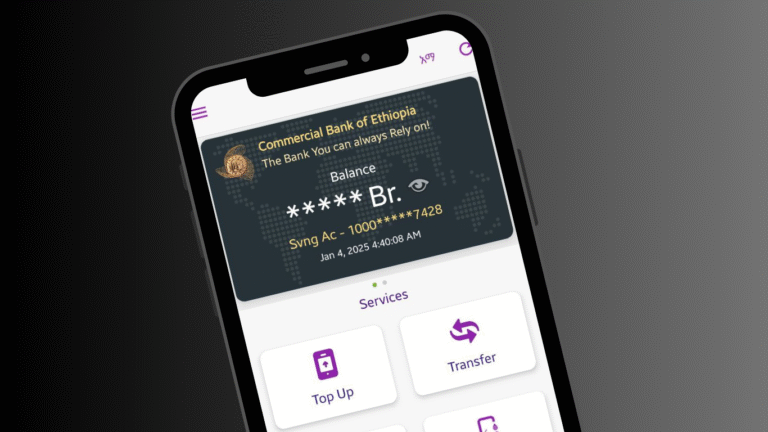



Commercial Bank of Ethiopia (CBE) is set to revise its service fees for the second time in two years, with the changes taking effect on September 29, 2025. The announcement has already triggered some kind of pushback on social media, well before the fees are even implemented. This reaction is not new. When CBE first introduced service charges two years ago, the backlash was intense, dominating conversations on radio, television, and online platforms for months.
The public frustration is understandable. No one welcomes additional costs, especially when they are tied to services people have grown used to enjoying for free. But the conversation often overlooks a critical question: what value are customers actually receiving in return?
The Value of Digital Banking
CBE’s investments in digital banking have transformed the way millions of Ethiopians interact with money. A decade ago, simple transactions such as sending or receiving funds could take days, and even then, customers would spend hours in queues at crowded branches. Every payment, school fees, utility bills, airtime purchases, rent, or government charges, required a physical trip, additional taxi fare, and the loss of valuable time.
Today, thanks to mobile banking, internet banking, POS machines, and digital wallets, those inconveniences are largely a thing of the past for those who are already banked.
Now imagine the alternative. Without digital banking, a customer would need to visit the nearest branch at the current minimum taxi fare of ETB 10 each way, which means ETB 20 for a round trip, plus one or more hours of waiting and queuing. If your time is worth even ETB 20 an hour, that one visit already costs ETB 40. Repeat that twice a month and you have already spent ETB 80, not counting the stress, lost opportunities, and the fact that branches do not operate 24/7 and the extra hassle of dealing with weather, whether it is the sun burning, heavy rain, or the cold.
Multiply that cost further if you have to make multiple trips for different payments such as school fees, utilities like water, electricity and internet, airtime, rent, passport, tax, traffic penalties, DSTV, airline tickets, and many other public or private services, and even then you would still face the usual queues at each office.
The Costs Behind the Convenience
There is also a misconception that digital banking is “cheap” for banks to provide. In reality, maintaining a secure, reliable, and scalable digital infrastructure is enormously expensive. CBE spends billions of birr annually on technology infrastructure, staff training, security, and round-the-clock system maintenance. Most of these costs involve international vendors, require payments in foreign currency, and these vendors rise service prices steadily over time.
Some may argue that digitizing services not only makes banking cheaper for customers but also reduces costs for the bank itself. That is true in the very long run, but only after decades of sustained investment. In the short and medium term, the reality is the opposite. Banks must keep reinvesting heavily just to maintain systems, upgrade capacity, and cover vendor demands.
A good example is Telegram. Since its founding in 2013, the company operated at a loss for more than a decade, surviving only through its founder Pavel Durov’s funding and debt financing. It became profitable for the first time in its history in 2024. That journey shows how digital platforms require massive upfront investments and patience before returns materialize. CBE is no different. For many years it has shouldered the entire cost of digital banking to build the infrastructure customers now rely on every day.
For over a decade, these services were offered free of charge, with CBE carrying the burden of the costs while customers enjoyed the benefits. But no institution can carry that weight forever. Introducing fees is not about profiteering, it is about ensuring sustainability.
Related article from the author: Understanding the Rationale Behind Commercial Bank of Ethiopia’s New Banking Fees
Phased Implementation
It is worth noting that when CBE first introduced service charges in 2023, it did so gradually and selectively. Out of all mobile banking transactions, 85 percent were below ETB 10,000 and remained completely free of charge. Only 15 percent of transactions, those involving transfers above ETB 10,000, were affected. Even then, the charges were minimal: ETB 3 for transfers up to 50,000, ETB 5 for 50,001–100,000, ETB 10 for 100,001–200,000, ETB 15 for 200,001–300,000, and a maximum of ETB 20 for amounts above 300,000.
However, there was a loophole. Customers could avoid service charges by splitting large transfers into smaller amounts. For example, to transfer ETB 20,000, many would simply make two transfers of ETB 10,000 and effectively avoid paying the fee. In fact, a significant number of customers have been using this trick.
Beyond Fees: A Call for Perspective
The debate over service charges should not only be about cost. It should also weigh the value gained, the savings in time and effort, and the sustainability of a modern banking system. Digital transformation requires massive, ongoing investment. To demand the benefits of convenience while resisting any contribution toward its upkeep is to miss the bigger picture.
Because of the digital banking infrastructure CBE pioneered, people’s lives are now easier, simpler, and far less burdened by the old routines of traditional banking. That achievement should not be overlooked when evaluating the new charges.
The new fees may spark another round of debate. But if the conversation shifts from reaction to understanding, customers and the bank alike will be better positioned to move forward.
____________________________