


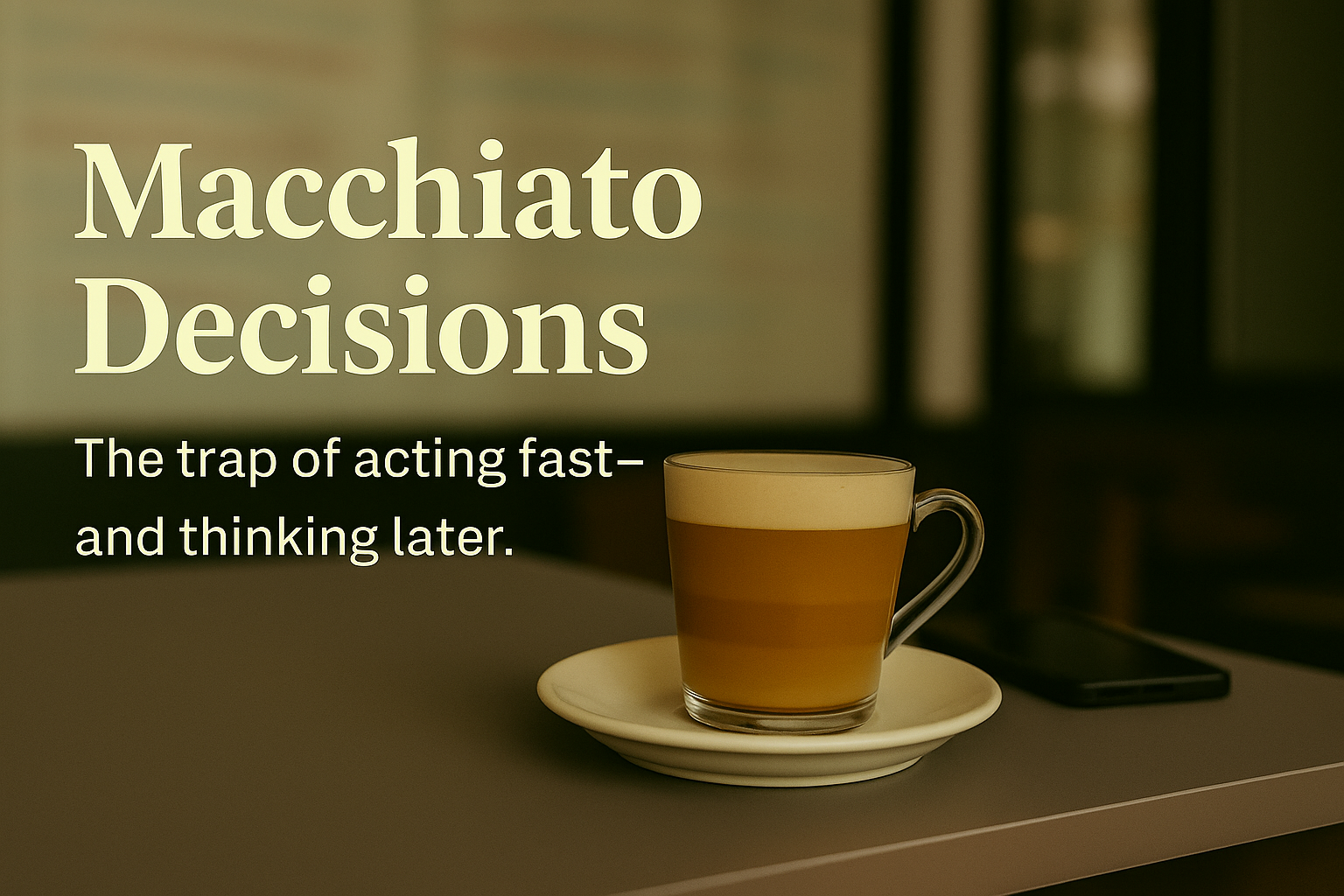
In executive suites, political arenas, and everyday life, a subtle but costly pattern emerges: decisions made in haste, often over coffee or under pressure, without thorough analysis or planning. The consequences are typically predictable: stalled projects, flawed policies, or regretful outcomes.
I call this the macchiato decision.
It’s a phrase born from observing choices made in casual or high-stress moments, decisions that feel urgent or inspired but lack the grounding of structure, foresight, or consultation.
What Is a Macchiato Decision?
A macchiato decision is an impulsive or pressure-driven choice made without adequate planning, collaboration, or consideration of long-term implications.
It typically occurs in two situations:
- Relaxed spontaneity: A casual setting, such as a coffee break, where ideas spark without strategic vetting.
- Reactive urgency: A high-pressure moment where people take action to relieve stress or appear decisive.
In both cases, the decision feels right in the moment—but it tends to unravel later.
Origins of the Term
The term came from a recurring pattern I noticed during leadership interactions. Some of the most consequential decisions, restructuring teams, launching new projects, shifting priorities, originated informally during coffee breaks, often while sipping a macchiato. These ideas, sparked in passing, quickly escalate into action: leaders send emails, alert teams, and allocate budget and resources.
However, these decisions usually skip follow-up research or planning. When outcomes falter, people often ignore, downplay, or offload the consequences onto others.
Over time, I saw this same pattern under stress. Pressure pushes people, leaders, workers, and individuals alike, to act quickly. The hope is to solve problems or maintain control, but the result often makes things worse.
Real-World Examples
In Business
A CEO, trying to match a competitor’s pace, launches a half-baked product. They rush development. Market research? Skipped. The launch fails, and employees, not the strategy, take the blame.
In Politics
Under media pressure, a politician announces a policy on the fly. It sounds strong but lacks legal grounding and stakeholder input. As a result, implementation flops and credibility takes a hit.
In Everyday Life
An individual accepts a job offer without assessing culture or role alignment, just to escape their current stress. A few months later, they’re back to square one, feeling disillusioned.
Why Macchiato Decisions Happen
- Cognitive overload : The brain craves shortcuts under pressure, so it defaults to quick decisions.
- Cultural pressure: Many reward leaders for speed, even when thoughtful planning leads to better results.
- Illusion of simplicity: Complex problems can seem deceptively manageable in informal settings, especially during moments of calm or urgency.
The Consequences
- Wasted resources: Teams waste money, time, and energy on unvetted initiatives.
- Credibility erosion: When decisions collapse, trust in leadership declines.
- Crisis amplification: Quick fixes often deepen long-term risks instead of solving them.
- Emotional fatigue: Individuals end up suffering from regret, disillusionment, or burnout.
How to Avoid Macchiato Decisions
- Pause before action: Even 30 minutes of reflection can shift the outcome significantly.
- Seek input: Involve experts, teams, or mentors to get a broader context.
- Use frameworks: Apply tools like SWOT, decision trees, or pre-mortem analysis.
- Normalize patience: Build a culture where slowing down is a sign of strength, not hesitation.
Conclusion: Recognize the Pattern
Not every spontaneous decision is harmful. But when hasty action becomes a habit, the consequences compound. In naming the macchiato decision, we create language for a behavior many recognize but rarely label. It’s a reminder to reflect before reacting, to lead with intent, not impulse.
So, next time an idea strikes over coffee, or in a crisis, ask yourself:
Am I making a macchiato decision?




This is interesting! I see this kind of decisions a lot in my own experience. Great to have a name for it.
Thanks 👍 Kibrom. Glad you liked my pieces.
Very interesting, and insightful 👍. I have seen myself in it.
Insightful, thanks Sir.
Thanks dear Zelalem. I am happy you get some insights from my content.
Dear I consider it as a useful view point with it’s attractive topic.
Thanks Lemi. Glade you liked my point of view and the topic too.
I actually like the name it is very relatable with the fact we witness in everyday activities.
Good job asre you kept amazing us
Thanks Afi for taking time to read my piece. Glad it’s relatable to you too as it is to me and to many others. Thanks
Thanks for sharing. This is so relatable as it happens a lot in personal and professional settings. While I agree that it is ideally preferable to analyse an issue to get full picture before decision,we should also recognize that one may not always have the luxury of time to do that. Striking the right balance between speed and accuracy is one of the toughest challenges in decision making…decide too quickly,you risk making errors ,perhaps costly ones;decide too late,you risk losing an opportunity in a dynamic business environment. Too much of analysis some times leads to indecisiveness termed as ‘analysis paralysis’ . I think,understanding the decision context (time available,what’s at stake..) is the key to make right decisions.
Absolutely, Mulualem! I completely agree, striking the right balance between quick and deliberate decision-making is crucial, and as you rightly pointed out, context matters: the time available, the resources at hand, and the stakes involved all play a role.
That said, the core idea I was trying to convey in the article wasn’t so much about everyday or smaller decisions, where spontaneity may be acceptable or even necessary. My focus was more on high-stakes, consequential decisions those that carry significant long term impact or cost. In those cases, even a short pause for reflection, say 30 minutes, can make a substantial difference in the outcome.
As I also mentioned toward the end of the article, not every spontaneous decision is necessarily harmful, sometimes you get lucky, and sometimes the consequences are minimal. But for the big calls, thoughtful consideration is often what separates good outcomes from costly mistakes.
Thanks again for engaging, your point adds valuable nuance to the discussion.
Very relatable and clearly explained. It is always important to evaluate decisions, knowing what impact they would create.
Thank you.